
Finding specialized talent shouldn’t slow down your growth
For many companies across the United States and Canada, growth no longer depends on demand alone. It depends on access to the right talent.
Hiring timelines are getting longer. Competition for specialized professionals continues to increase. Internal teams are often stretched thin, while new projects require capabilities that are difficult to build quickly.
As businesses scale, traditional hiring models can become expensive, slow, and inflexible.
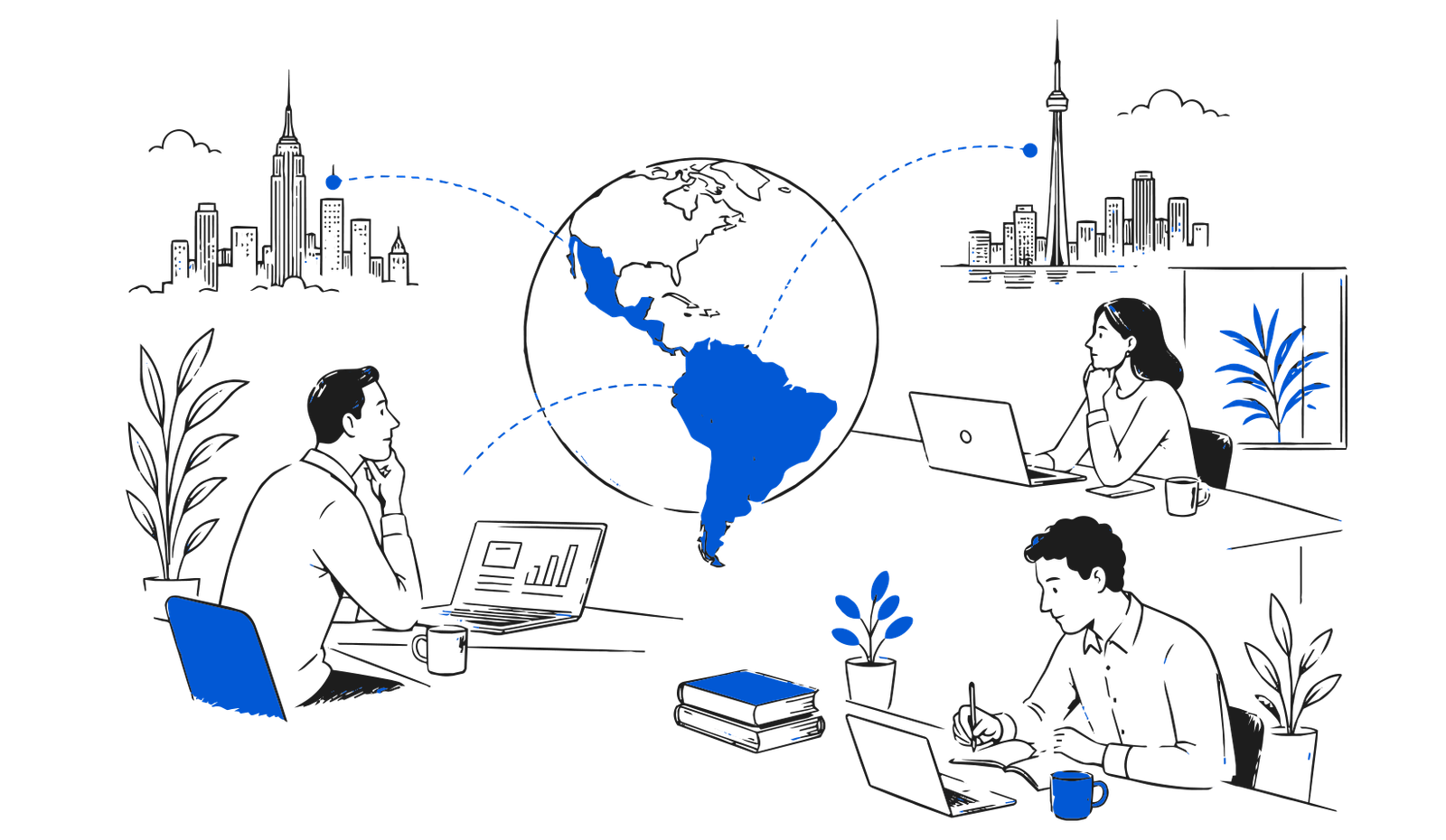
This is why more organizations are turning their attention to Latin America.
A new approach to building high-performing teams
Remote talent in Latin America offers companies access to highly skilled professionals across areas such as design, digital marketing, audiovisual production, software development, operations, and project management.
Beyond technical expertise, organizations benefit from three critical advantages:
Time zone alignment
Working with professionals located in similar time zones enables real-time collaboration, faster decision-making, and seamless communication.
Cultural compatibility
Teams across Latin America often share business practices, communication styles, and customer-centric approaches that align naturally with North American organizations.
Flexible growth
Whether you need a single specialist or an entire team, remote staffing models allow businesses to scale according to business needs without adding unnecessary operational complexity.
The real value goes beyond cost savings
While optimizing hiring costs is important, the greatest advantage of remote teams is agility.
Companies that can access specialized talent quickly are better positioned to innovate, launch projects faster, and respond to changing market conditions.
The question is no longer whether remote work is viable.
The question is whether your organization has a talent strategy designed for today’s global market.
Building remote teams successfully
Successful remote hiring requires more than sourcing candidates.
It requires a structured process that includes:
- Clearly defined role profiles
- Rigorous candidate evaluation
- Effective onboarding
- Ongoing support and communication
- A strong focus on team integration and culture
When these elements come together, remote teams become an extension of your business—not an external resource.
The future of work is borderless.
The companies that embrace it early will gain a lasting competitive advantage.
Ready to explore remote talent in Latin America?
Discover how your organization can build flexible, bilingual, and high-performing teams designed to support sustainable growth.